Andrea Bocelli sings a final farewell to Elara, the blind 9-year-old girl who fell asleep each night to his voice


Andrea Bocelli sings a final farewell to Elara, the blind 9-year-old girl who fell asleep each night to his voice
Andrea Bocelli sang for Elara… one last time.
Elara Grace was 9 years old. She was born blind… but she saw the world differently. Through sounds, through melodies. And most of all, through the voice of Andrea Bocelli, whom she listened to every night before falling asleep.Her favorite moment? Whispering “Con te partirò” along with him, just before drifting into dreams.
Her dream? To hear him sing live. Just once.
But time ran out.
Elara passed away, taken by illness. Her family held a small, intimate farewell in a modest chapel. No one expected him to come. And yet…
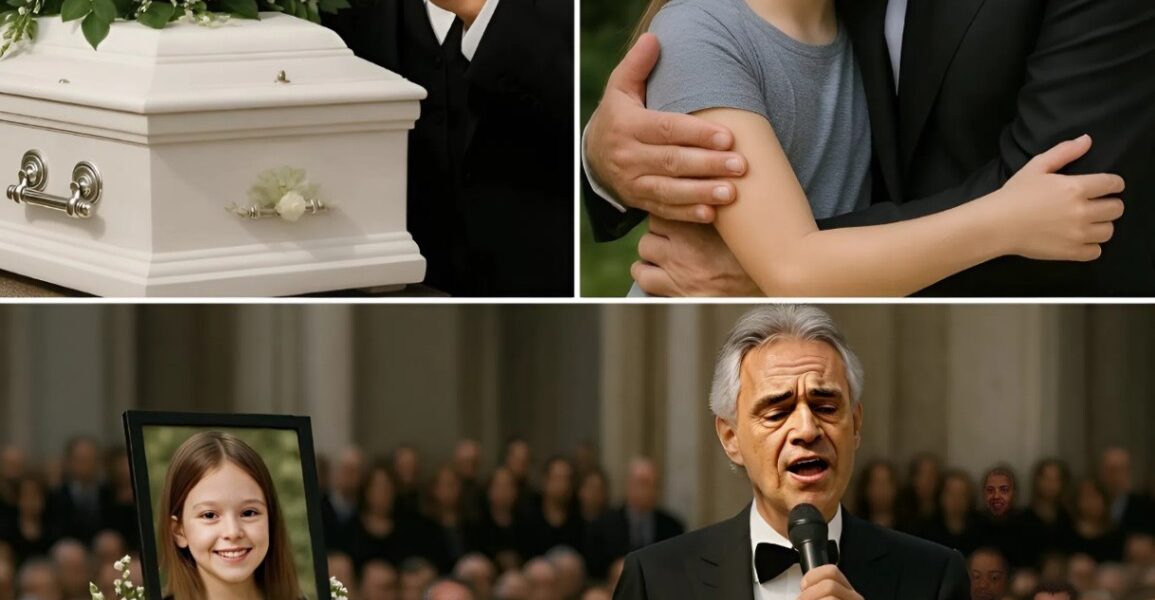
Andrea Bocelli arrived, silently. He laid a single white rose on her small coffin. Then, without a word, he sang.“Time to Say Goodbye.”
Just him… a piano… and a chapel frozen by emotion.
His voice carried an infinite softness… a blend of grief and peace. Even the tears seemed to hold their breath.
When the last note faded, he bowed before Elara’s parents… and quietly walked away.
A discreet farewell. But a moment forever etched in everyone’s heart.
Full video below
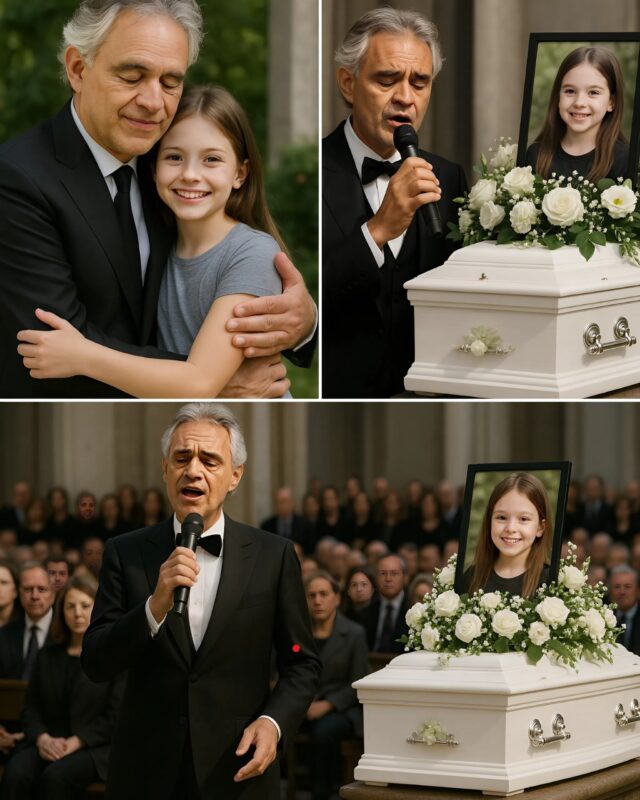
Andrea Bocelli sings a final goodbye to Elara, the blind 9-year-old girl who fell asleep each night to his voice
Elara Grace was only nine, but her soul seemed to belong to a vaster world — one made of music and light. Born blind, she perceived the world differently — through vibrations, melodies, silences. And of all the voices she loved, Andrea Bocelli’s was the softest, the purest. Every evening, lulled by his songs, Elara whispered “Con te partirò” as she closed her eyes, hoping one day she could hear him live.
That dream never came true in her lifetime. A relentless illness took her too soon, leaving her parents devastated. During her funeral, an intimate ceremony was held in a small chapel. But that day, a silent miracle occurred.
No cameras, no announcement — Andrea Bocelli quietly walked in. He stepped toward the small white coffin, laid a pristine rose upon it, then sat at the piano. There, with a nearly celestial voice, he began “Time to Say Goodbye.”
No words, no sobs, no movement — only music floating in the air, heavy with sorrow and full of grace.
A murmur spread through the congregation: “His voice carried both pain and peace.”
When the last note faded, Bocelli rose, bowed respectfully to Elara’s parents… and left. Without a word.
A discreet farewell. But a moment engraved forever in every heart.

“Elara Grace, the girl who saw with her heart: a blue melody carried away by the flood”
The waters came like a silent scream — fast, unforgiving, turning the quiet streets of a Texas town into dark torrents. Within hours, homes vanished under a muddy sea. And amidst the chaos, a child’s fragile light was extinguished too soon: Elara Grace, age 9.
Elara wasn’t like other children. Born blind, she didn’t see the world — she listened to it. While others ran under the sun, Elara spent hours still, headphones on, wrapped in symphonies that painted inner landscapes for her.
Her favorite universe had a name: Andrea Bocelli.
“She loved the color blue,” her mother Rachel says, voice trembling. “When Bocelli sang, she said she saw blue. That his voice was the color blue.”
It wasn’t just listening — it was a full immersion. She knew every inflection of “Con te partirò,” every breath in “The Prayer,” which she sang herself with a delicate but steady voice, like a bird dreaming of the sky. Her room, a sanctuary of blue, was covered in it: sheets, curtains, string lights… And above her bed, carefully framed, hung a poster of Andrea Bocelli like a sacred image.

“She once told me: ‘Mom, when he sings, I forget I can’t see. It’s like he draws pictures for me — with his voice.’ How do you explain that?”
On the day of the tragedy, Elara had just sung at school. Dressed in a royal blue dress, she performed “Ave Maria” for her classmates. One last note hanging in the air… one final shiver.
Just hours later, the storm hit. Their neighborhood was swallowed during the night. Rachel recalls holding Elara and her little brother, trying to flee through waist-high icy water. A sudden wave knocked them down. When she resurfaced… Elara was gone.
“She was just there… and then… nothing.”
Rescue teams searched through the night. She was found in the morning, nestled against the roots of an old oak tree, still clutching her small blue music player.
Her story moved the entire community. A local news station broadcast her rendition of “Time to Say Goodbye,” and someone sent it to Bocelli’s team. No one expected a reply.
But three days later, the unimaginable happened.
At the intimate ceremony in the village church, just as Rachel was about to speak, a hush fell. A figure stepped forward: tall, dressed in black. It was him. Andrea Bocelli.
Without a word, he placed a light blue rose on Elara’s coffin, approached the piano, and sat down. Eyes closed, he began to sing “The Prayer,” his voice so pure that time itself seemed to pause. Some wept openly. Others remained motionless, pierced by emotion. Even those who didn’t know him felt the depth of the moment.
When the last note faded, Andrea bowed his head gently… and left. No speech. No cameras. Just a silent farewell offered to a child who had found, in his voice, an entire world.
Outside, the rain had stopped. A beam of sunlight timidly broke through the clouds.
And for a brief instant, it felt as though Elara’s world — one of music, of blue, and of inner light — had embraced our own.
“She loved blue,” Rachel whispered. “She loved music… and she loved him. I believe she knows he came.”
In the weeks that followed, a wall at her school was transformed into a mural: a sky swirling in blues, floating musical notes, and the gentle silhouette of a little girl holding a flower. Beneath it, the words Elara once shared with her teacher:
“You don’t need eyes to see beauty. Just a song.”